
Chair exercises for the elderly: simple and safe
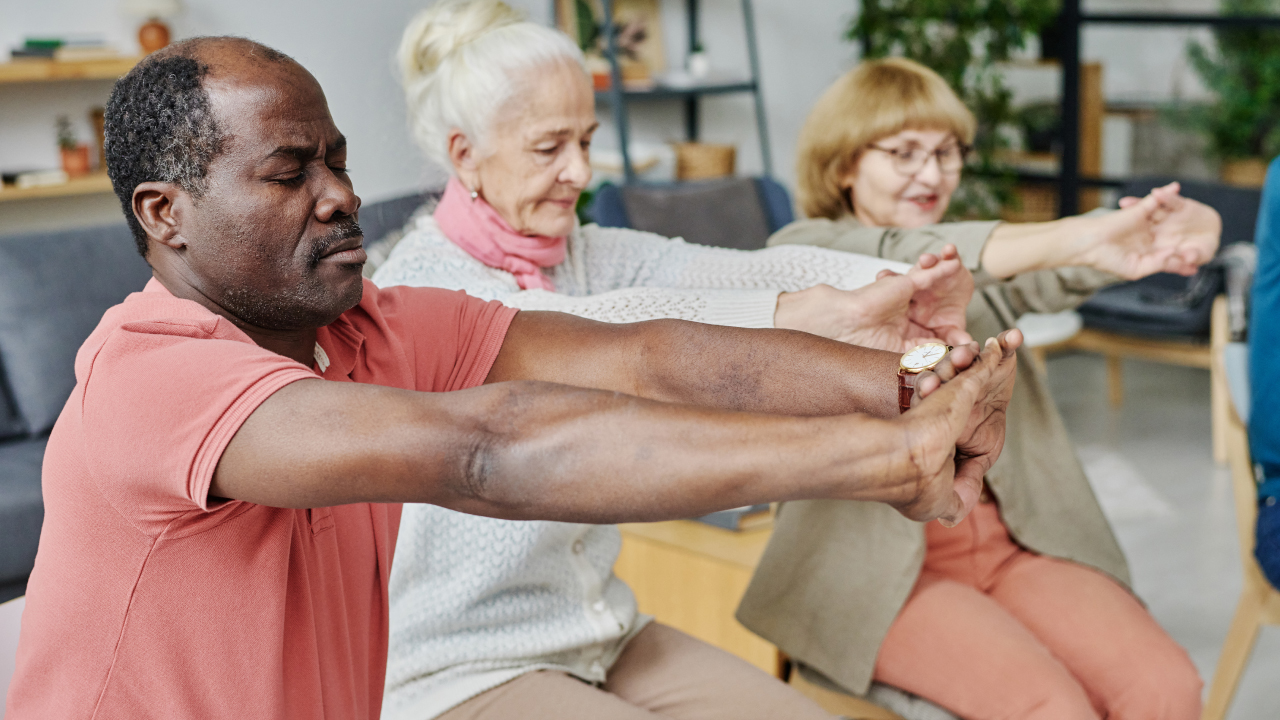
There are several simple, safe options that help to improve strength, circulation and wellbeing. In this article, we share safe suggestions for seated exercises, ideal for doing at home or in care settings, which respect each person's limits and pace.
Key points of this article
- Physical activity is essential for older people, even those with reduced mobility, and it can be done safely with seated exercises
- These exercises improve circulation, muscle strength, balance and emotional wellbeing
- The article presents 2 stretches and 5 exercises that are easy to perform with or without accessories
- It includes guidance on frequency, safety, contraindications and tips for adapting the exercises to each older person's situation.
Why are they important?
Regular physical exercise, even when adapted, can improve circulation, strengthen muscles, ease joint pain and contribute to older people's physical and emotional wellbeing. Each person's physical needs must be respected; seated exercises carry a low risk of injury and can achieve the same results as standing exercises. They also promote independence, support wellbeing and make inclusion easier.
What kind of chair should you use?
Choosing the right chair matters so that the exercises are done correctly: it should not have wheels and should be comfortable. It is essential that the back is kept straight and stable.
How often should you practise?
According to the WHO (World Health Organization) exercises should be done 2 to 3 times a week, in sessions of 20 to 30 minutes. However, the most important thing is to combat a sedentary lifestyle and encourage physical activity. Older people should start with small activities and gradually increase the frequency, duration and intensity, as far as is possible given each person's specific needs.
List of chair exercises and suggestions on how to practise
Before any physical activity, stretches are essential, so that there is no risk of injury. They improve blood circulation and warm up the muscles.
Here are two examples of stretches for older people:
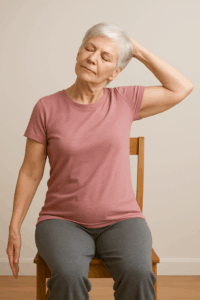
Neck stretch
- Sit with your back straight and your feet firmly on the floor
- Slowly tilt your head to the left side
- Hold the tilt until you feel a gentle stretch on the right side of your neck
- Still in that position, extend your right arm downwards and slightly out to the side
- Hold the stretch for 15 to 20 seconds, and remember to breathe slowly
- Return carefully to the neutral position
- Repeat the exercise on the other side (head towards the right shoulder, left arm extended)
- To finish, you can slowly rotate your head in a full circular movement (360°), gently and without forcing it.
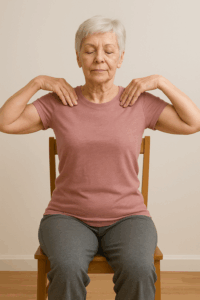
Shoulder circles
- Sit with your back straight and your feet firmly supported on the floor
- Place your fingertips on your shoulders, with your elbows pointing out to the sides
- Make forward circles with your elbows, rotating your shoulders
- Repeat the movement 15 times forwards, slowly and in a controlled way
- Then reverse the direction: make backward circles with your elbows
- Repeat the movement 15 times backwards
- Keep your breathing calm throughout the exercise.
After stretching, here are 5 exercises that work both the upper and lower body:
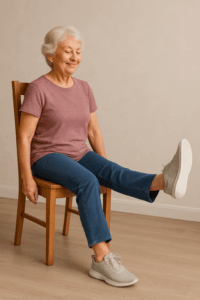
1. Alternating leg raises
Helps to strengthen the thighs and improve circulation.
- You should be seated with your back straight and your feet on the floor
- Extend one leg forwards and hold it in that position for 3 to 5 seconds
- Return to the starting position and repeat with the other leg
- You should do 10 repetitions with each leg.
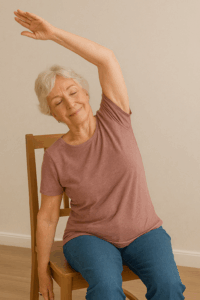
2. Side stretch of the torso
Improves flexibility and helps to relieve tension.
- With your feet on the floor, raise your right arm above your head
- Lean your torso slightly to the left side
- Hold the position for 10 seconds and return to the centre
- Repeat on the opposite side. Do this 3 times on each side
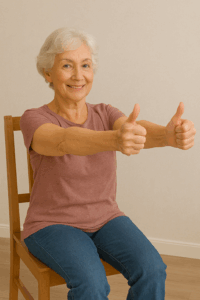
3. Pulling the arms back (squeezing the shoulder blades together)
Strengthens the upper back.
- Extend your arms forwards, with your thumbs pointing up
- Pull your elbows back as if to “open your chest”
- Squeeze your shoulder blades together and hold for 2 seconds
- Extend your arms again. Do 10 repetitions.
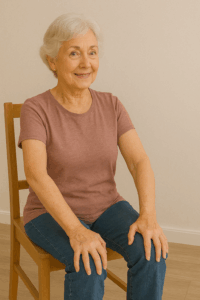
4. Pressing the hands against the knees
Activate the abdominal area safely.
- Place your hands on your knees and press as if to push them down
- At the same time, press your legs up against your hands
- Hold the pressure for 5 seconds and relax
- Repeat 8 to 10 times.
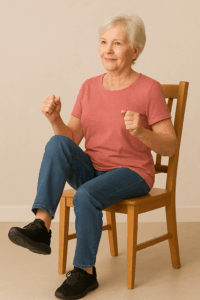
5. Marching on the spot (seated version)
Activates circulation and improves coordination.
- Sit with your back straight and raise one knee at a time
- Alternate your legs, as if “marching” while seated
- Keep the rhythm going for 30 seconds to 1 minute
- Rest and repeat 2 or 3 times.
Precautions before you start
Before older people begin this physical activity, it is important to pay attention to the following precautions:
- Choosing the chair: comfortable, but allowing the back to stay straight and stable
- Attending classes or having the help of a professional
- Respecting the body's limits
- Comfortable clothing
- Supervision: to ensure safety and motivation.
Who can (and cannot) take part?
These exercises are safe and beneficial for almost all older people; however, extra care and attention is needed in some cases.
Suitable for:
- Older people with reduced mobility, wheelchair users or those with balance difficulties
- People recovering from surgery
- Older people with mild chronic conditions (such as diabetes or controlled high blood pressure)
Anyone who wants to maintain or improve strength, circulation and flexibility without the risk of falls.
Avoid, or consult a doctor first:
- Older people with heart conditions or respiratory problems
- People with acute pain, recent inflammation or joint/muscle injuries
- Anyone who experiences frequent dizziness, fainting or shows signs of disorientation.
Simple accessories to complement the exercises
Using accessories complements some of the exercises, helping to increase resistance, improve balance and make the exercises more dynamic and motivating for older people. They should be used with care and according to each person's ability.
Recommended accessories:
- Light weights (dumbbells or ankle weights): strengthen the arms and legs with some added resistance
- Resistance bands: work the strength and mobility of the arms and legs with controlled movements
- Small exercise ball (stress ball or pilates ball): can be used between the knees or hands to build strength and improve coordination
- Broom handle: helps to stretch the arms and shoulders and improve posture
- Music: music encourages rhythm, good spirits and energy.
Remember that: accessories should be light and easy to use and used under supervision, sudden movements should be avoided, and each accessory should be adapted to each person's situation.
Is it safe to do these exercises at home?
These exercises are safe to do at home as long as precautions are taken (the environment is suitable and the person respects their own limits). Seated exercises are one of the safest ways to stay physically active in later life, especially for those with reduced mobility.
However, a few precautions make all the difference:
- Use a firm, stable chair without wheels, ideally with a backrest and armrests
- Avoid loose rugs or objects on the floor that could cause slips
- Keep the space well lit and ventilated
- Have support nearby, such as a family member or carer, during the first sessions
- Start with light, short movements, gradually increasing as comfort allows
- Stop immediately if there is pain, dizziness or any feeling of unwellness
- Drink water to stay well hydrated.
Benefits for independence and wellbeing
They may seem simple, but seated exercises have a significant impact on older people's quality of life, physically as well as emotionally and socially. In terms of independence, they strengthen the muscles, help maintain independence and improve posture.
When it comes to wellbeing, they boost an older person's self-esteem, reduce symptoms of anxiety and depression and help to build a routine.
It is important to encourage these habits in order to combat a sedentary lifestyle and isolation.
Caring for the body in later life is not only a matter of health. It is a way of preserving dignity, encouraging independence and strengthening social bonds. Seated exercises, as well as being accessible and safe, are an invitation to movement, joy and engagement. With small daily gestures, it is possible to transform older people's routines, promoting more than mobility: quality of life.
Seated exercises are more than just exercise: they are moments of connection, self-esteem and joy for older people.
Need non-emergency patient transport?
Ambula handles everything — with comfort, punctuality and care.
Book a transport