
Find out how a pregnancy test works and when it is best to take one

Doubt knocks at the door and your heart races. Could it be? It is natural to feel anxious, with a thousand questions in your head: “Am I pregnant?" "When should I take a pregnancy test?" How does it really work?”. If you are going through this moment, take a deep breath – this article is for you.
Here, we explain everything you need to know about pregnancy tests, from how they work to the right way to take them. And because the internet is full of myths and home-made solutions, we also reveal what is true and what is not. Ready? Let''s get started!
What is a pregnancy test and how does it work?
A pregnancy test is a simple, effective way to find out whether you are pregnant. It works by detecting a hormone called hCG, which begins to be produced after the fertilised egg attaches to the wall of the uterus, generally between six and 10 days after fertilisation. First, hCG appears in the blood and, shortly afterwards, it can already be found in the urine. It is this hormone that the tests look for in order to give you the answer you are so eager for.
There are two main types:
- Urine test: can be done at home with a stick bought at the pharmacy. It is quick and easy to use
- Blood test: carried out in a laboratory, it is more sensitive and lets you know not only whether you are pregnant, but also how far along the pregnancy is.
When should I take a pregnancy test?
The ideal time to take a pregnancy test is from the first day of a missed period. At this point, hCG levels are already high enough to be detected. However, if you do not have regular cycles or if you have had unprotected sex recently, the test will only be considered definitive 19 days after intercourse.
If you choose to take the test before a missed period, choose a more sensitive test that can be used up to 6 days before the expected date of your period. An example is the Clearblue Digital Ultra Early.
For greater reliability, take the test in the morning, with the first urine of the day, which has a higher concentration of hCG.
How to take a pregnancy test?
Taking a pharmacy pregnancy test is simple:
1. Take the stick out of the packaging and remove the cap
2. Place the absorbent tip under the stream of urine for a few seconds or dip it into a collected urine sample
3. Put the cap back on and leave the stick on a flat surface
4. Wait for the time indicated in the instructions (usually 1-3 minutes)
5. Read the result:
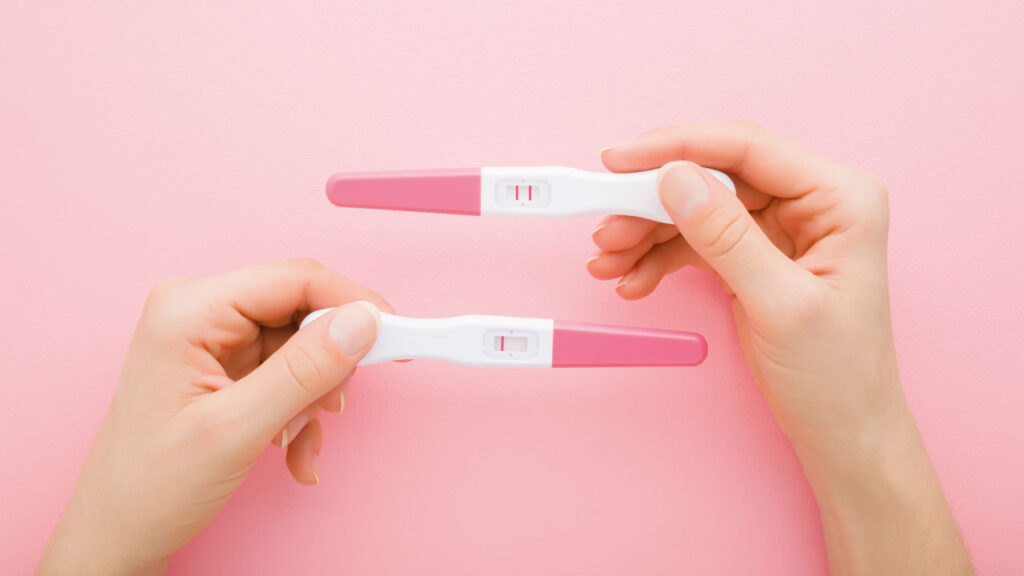
- Positive: two lines appear or the word "Pregnant"
- Negative: only one line appears or the words "Not pregnant".
If the result is not clear (for example, a very faint line), repeat the test after a few days.
What is a false positive?
A false positive occurs when the pregnancy test indicates that you are pregnant, but in fact you are not. Although pharmacy tests are quite accurate, some factors can lead to this kind of result, such as:
- Use of medication containing hCG (such as fertility treatments)
- The presence of cysts on the ovaries or other health conditions
- An out-of-date test or one that has been poorly stored
- Early pregnancy loss, as in a chemical pregnancy
If you have a positive test and doubts about its reliability, it is always advisable to confirm with a doctor.
And a false negative?
A false negative, on the other hand, happens when the test indicates that you are not pregnant, but in fact you are. It can occur in situations such as:
- Taking the test too early, before hCG levels are detectable
- Diluted urine, especially if you drank a lot of fluids before the test
- Errors in the procedure, such as not following the instructions correctly
- Low-sensitivity tests, less able to detect early hCG levels.
If you have pregnancy symptoms and the test is negative, it is advisable to repeat it a few days later or consult a doctor for clarification.
The myth of foolproof home-made pregnancy tests
With so many suggestions circulating on the internet, many women may feel tempted to turn to a home-made pregnancy test to try to get a result before taking the pharmacy test. The truth, however, is that home-made options are not reliable and have no scientific basis whatsoever. Some methods, such as the home-made pregnancy test with saliva, with vinegar, with sugar or even the home-made pregnancy test with lemon, are just popular myths that have been circulating for generations.
These methods, often called "foolproof home-made pregnancy tests", have no real power to detect the hormone hCG which, as explained above, is responsible for confirming a pregnancy. Instead, they rely on chemical reactions or popular beliefs that, at best, produce no effect at all, and, at worst, can give false or misleading results.
To ensure an accurate and safe answer, the best thing to do is to use pharmacy pregnancy tests, which are scientifically proven and have a high accuracy rate, more than any home-made pregnancy test.
The most common questions about pregnancy tests
The first signs include a missed period, nausea, tiredness and increased breast tenderness. Confirm with a pregnancy test.
Generally, from 1-2 weeks after conception, depending on the type of test used.
From the first day of a missed period or 19 days after unprotected intercourse.
Follow the instructions on the packaging, placing the stick under the stream of urine or dipping it into a collected sample.
Ideally, in the morning, with the first urine of the day (for a higher concentration of hCG in the urine).
Prices range between five and 20 euros, depending on the brand and features of the test.
At pharmacies, supermarkets or online.
Need non-emergency patient transport?
Ambula handles everything — with comfort, punctuality and care.
Book a transport